Tango films that were never released (sound era)
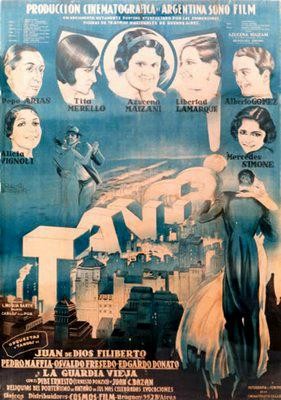
Argentine cinema put tango on screen from the start. The first Argentine sound feature, Tango! (Luis Moglia Barth, 1933), was built around it, and hundreds of comedies, dramas and documentaries followed. Most reached cinemas. A few did not: some were never finished, others were finished but never released commercially. This page lists the known cases from the sound era, based on research by the writer Marcelo H. Oliveri of the Academia Porteña del Lunfardo.
Overview
| Year | Title | Director | What happened |
|---|---|---|---|
| 1942 | Academia “El Tango Argentino” | Julio Irigoyen | Shot, never shown |
| 1954 | Soy del tiempo de Gardel | Homero Cárpena | No cinema release; later shown on television |
| 1969 | Tango argentino | Simón Feldman | Shown only at festivals and private screenings |
| 1973 | Hasta siempre Carlos Gardel | Ángel Acciaresi | Unfinished |
| 1978 | Tango, canción de Buenos Aires | Abel Beltrami | Only the first of three episodes was shot |
| 1978–79 | El tango en el cine | G. Fernández Jurado, R. Corral | One screening in Buenos Aires (1980), no commercial release |
| 1981–82 | Buenos Aires Tango | Julio Saraceni, Jorge Briand | Finished after a pause; never released |
| 1984 | Tango y Tango | Mauricio Berú | Shown abroad, never in Argentina |
| 1988 | Argentina es tango | Carlos Borcosque | Abandoned |
| 1993 | Muchas gracias, maestro | Luis Segura | Unfinished |
| 2001 | Notas de tango | Rafael Filippelli | Festival premiere only |
Can you watch them today?
As of October 2026 we found no official release of any of these films on YouTube, streaming services or DVD. Unofficial uploads under other titles cannot be ruled out. Several of them only ever existed as festival copies, and some were never finished. Where a reference entry exists, it is linked under each film below.
If you know of a copy in an archive or online, let us know.
The films
Academia “El Tango Argentino” (1942)
Shot by Julio Irigoyen with Elisa Labardén, Domingo Conte, Herminia Velich, Ada Cornaro and Tino Tori. It was never screened.
Reference: Wikipedia (es)
Soy del tiempo de Gardel (1954)
Directed by Homero Cárpena, with Pedro Quartucci, Maruja Gil Quesada, Olga Lamas, Marcos Zucker and Eduardo Cobas. José Rapuano played Enrique Santos Discépolo, and Héctor Pacheco provided a singing voice. The film includes footage and recordings of Carlos Gardel singing fragments of Mi noche triste and Silencio. It never opened in cinemas but was later broadcast on television.
References: Wikipedia (es) · IMDb
Tango argentino (1969)
A 75-minute documentary by Simón Feldman (1922–2015), photographed by Juan Carlos Desanzo and co-produced with France, tracing the history of Buenos Aires music from its origins. It mixes animation, overseen by Francisco García Jiménez, with performances by Astor Piazzolla, Antonio Agri, Juan Carlos Cedrón, the Quinteto Guardia Vieja, the dancer Carmencita Calderón, Aníbal Troilo and others. It has only been shown at international festivals and private screenings; a German film archive catalogue from 1984 lists a 60-minute 16 mm copy.
References: Wikipedia (en) · IMDb · Arsenal Berlin catalogue (PDF). Not to be confused with Goran Paskaljević’s feature film Tango argentino (1992).
Hasta siempre Carlos Gardel (1973)
Ángel Acciaresi began filming a fantasy in which Gardel is allowed to return to Buenos Aires for 48 hours and meets his old friends. The cast included Julián Miró, the jockey Irineo Leguisamo, Tito Lusiardo and Palito Ortega. It was never completed.
Reference: Wikipedia (es)
Tango, canción de Buenos Aires (1978)
Abel Beltrami’s first feature, written by Abel Aznar, with Eduardo Ayala, Coco Fossati and Juan Valente. It was planned in three episodes; only the first was shot, and the director abandoned the project.
El tango en el cine (1978–79)
An 80-minute documentary by Guillermo Fernández Jurado and Rodolfo Corral on the relationship between tango and film, with texts by Jorge Miguel Couselo and Mariano Calistro and excerpts from more than 30 films. It was shown on 23 October 1980 in the Sala Lugones of the Teatro San Martín and at screenings abroad, but never released commercially.
Reference: Wikipedia (es)
Buenos Aires Tango (1981–82)
Julio Saraceni began this musical with a script by Abel Santa Cruz and a large cast that included Tincho Zabala, Silvio Soldán and Beba Bidart. Filming stopped soon after it started and was completed in 1982 by Saraceni’s assistant, Jorge Briand. The plot followed a young doctor who falls in love with another contestant on a television tango contest. It was never released.
References: Wikipedia (es) · IMDb
Tango y Tango (1984)
Mauricio Berú’s documentary, an Argentine–Cuban co-production with the Cuban film institute ICAIC, was filmed in Havana during the International Tango Festival of March 1984. It features Osvaldo Pugliese and his orchestra, Sebastián Piana, Astor Piazzolla, the Mosalini–Beytelman–Caratini trio, Eladia Blázquez, Nelly Vázquez and the poet Héctor Negro. It was shown at festivals in Latin America and Europe but never released commercially in Argentina. Sources give its length as 84 to 90 minutes.
References: Wikipedia (es) · IMDb
Argentina es tango (1988)
Carlos Borcosque (the son of the Chilean-born director of the same name) tried to make a film with lesser-known tango singers. The project failed.
Reference: Wikipedia (es)
Muchas gracias, maestro (1993)
A documentary about the life of Osvaldo Pugliese, then 87, directed by Luis Segura, who wrote the script with Lucho Schwartzman. It was to cover Pugliese’s childhood in Villa Crespo, his music, his political commitments and his relationship with his audience, with Luis Brandoni, Arturo Bonín, Marta Bianchi, Tato Bores, Héctor Alterio, Sandro and others in the cast. In August 1993 the director told La Nación that the production needed more support from the national film institute. The institute granted a loan, but rising costs made it impossible to finish post-production. The project is also linked to two unpublished Pugliese tangos, Compañera and Tokio luminoso.
In 2009 a bill in the Argentine Chamber of Deputies asked the government to take the steps needed to finish and screen the film (project 2135-D-2009, PDF). We have found no record that it was ever completed.
Not to be confused with San Pugliese (2024), a separate documentary by Maximiliano Acosta, Santiago Nacif and Lola Winer that premiered at BAFICI (Infobae, IMDb).
Reference: Wikipedia (es)
Notas de tango (2001)
A documentary by Rafael Filippelli (1938–2023), written with David Oubiña after a story by Osvaldo Pedroso, using music by Pugliese, Piazzolla, Osmar Maderna, Julio De Caro, Miguel Caló, Enrique Cadícamo and Juan Carlos Cobián. It premiered in April 2001 at the Buenos Aires International Independent Film Festival (BAFICI) but was not released commercially. IMDb dates it 2004.
References: Wikipedia (es) · IMDb
Related pages
Based on research by Marcelo H. Oliveri originally published on El Portal del Tango, revised and expanded with current references (October 2026).