Versalles and Monte Castro: two quiet barrios of Buenos Aires
Versalles and Monte Castro are two small residential neighbourhoods (barrios) in the west of Buenos Aires, close to Avenida General Paz. They are rarely mentioned in tango lyrics, but their history goes back to the colonial period, and the two cannot really be told apart: the land that is now Versalles was once part of Monte Castro.
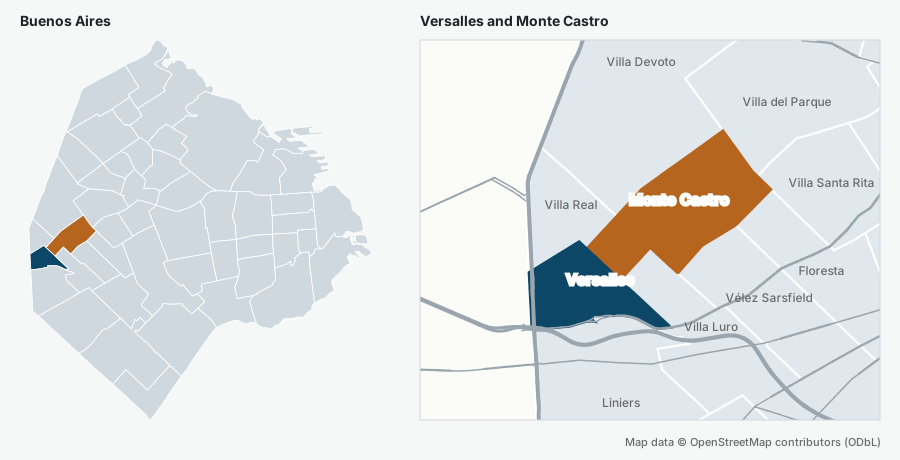
Monte Castro
The name comes from Pedro Fernández de Castro, who bought the land at the end of the 17th century from Francisco Rodríguez y Estela. It was known as the Chacra de Castro or Montes de Castro, partly because the area was wooded (willows, ombú trees, peach orchards). It is one of the highest parts of the city. In 1781 the Castro family sold the estate to Juan Pedro de Córdoba.
Casa del Virrey. On Calle Molière, between San Blas and Camarones, stood a large house known as the Casa del Virrey. Viceroy Sobremonte stayed there, and members of the Primera Junta are said to have met there in 1810 to organise the first army sent to Upper Peru. The house survived until 1940.
In 1827 the Córdoba family divided the land into three parts, which later became Liniers, Villa Luro and Versalles.
Cine Teatro Febo. Opened in 1929 at Avenida Álvarez Jonte 4455, this Renaissance-style cinema and theatre hosted radio dramas, carnival balls and tango singers including Ignacio Corsini, Mercedes Simone, Azucena Maizani, Libertad Lamarque and Nelly Omar. It closed in 1960.
The football club All Boys moved to the area in 1924 and has played at Mercedes and Álvarez Jonte since 1951. Monte Castro celebrates its day on 14 May.
Versalles
Versalles takes its name from Versailles near Paris. Councillor José Garrico proposed it after a trip to Europe, and several streets carry European city names (Madrid, Viena, Roma, Lisboa, Oporto, Bruselas). The barrio is mostly low houses, tree-lined streets and English-style or neo-colonial chalets.
The land passed from Manuel de Sarratea to the Visillac de Rodríguez family in 1849. A large subdivision by the Compañía de Tierras del Oeste in 1911 marks the real start of the barrio. Even with two railway branches, people were slow to settle so far from the centre, partly because electricity arrived late.
El trencito de Versalles. A small electric tram with miniature carriages ran from Villa Luro to Versalles along Irigoyen, Juan B. Justo, París, Barragán and Porcel de Peralta. Locals remembered it fondly; it stopped running on 6 October 1952.
Vélez Sársfield played its early matches at Cortina and Bacacay from 1915. By the 1930s the barrio had its own social and cultural clubs, including the Ateneo Versalles and the Belisario Roldán public library. Versalles celebrates its day on 16 November.
Squares. The Plazoleta José Eusebio Agüero is named after the priest who was rector of the Colegio Nacional de Buenos Aires. The Plazoleta Belisario Roldán (1960), at Ghana and Santo Tomé, still has the old granite paving of Calle Ghana.
Versalles in tango
Few tangos mention these barrios:
- El vino triste (1939), lyrics by Manuel Romero, music by Juan D’Arienzo. Sung by Hugo del Carril in the film Gente bien.
- Don Alfonso, by Héctor Varela and Eladio Blanco, dedicated to police commissioner Alfonso Ibarborde, a well-known local figure.
- La musa mistonga (1926), lyrics by Celedonio Flores, music by Antonio Polito, recorded by Rosita Quiroga for Victor. It mentions Versalles, although the reference is to the French palace and not the barrio.
Related pages
- Juan D’Arienzo
- Milongas in Buenos Aires today: tangoportal.com
Based on an article by Marinha Villalobos from the series “Los Cien Barrios Porteños”, originally published on El Portal del Tango, revised and expanded.